Add another reward
When this step is done, a customer who claims their first reward still has something to aim at.
In EarnKit: Program › Rewards
Your program works with one reward. It stops working the moment somebody claims it.
A customer who has just spent their points is at zero with nothing in front of them, which is the same position as a customer who never joined. A second, larger reward is what turns redeeming into a checkpoint rather than an ending.
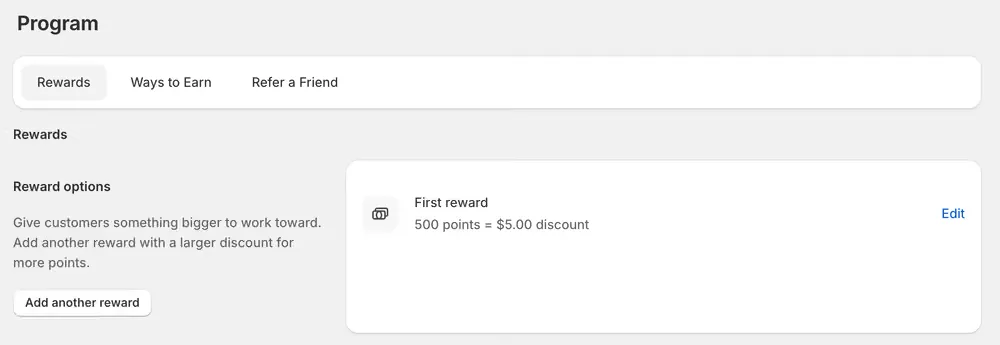
Choose the next rung
Add another reward takes the same two numbers as the first: what it costs in points, and what it takes off an order.
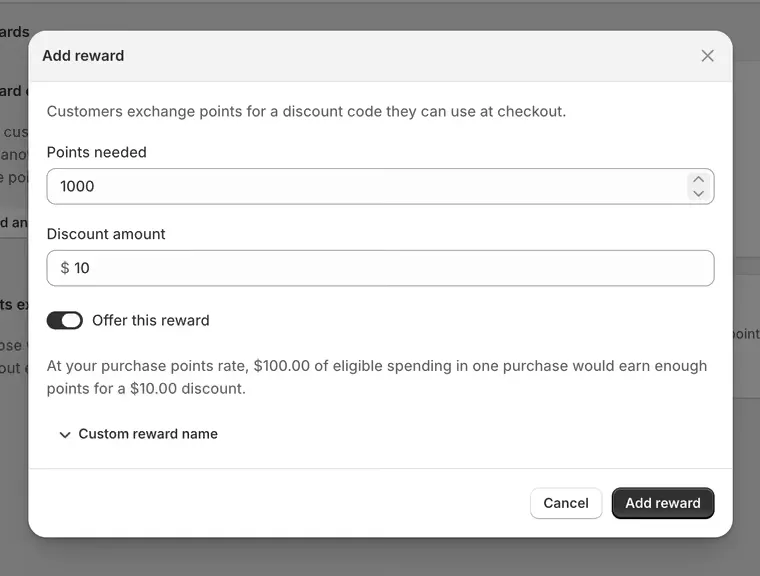
As you type, EarnKit works out the consequence in the only unit that matters to a customer: how much they would have to spend in one purchase to earn it. Use that line rather than the points figure to judge whether the rung is reachable.
Offer this reward controls whether customers can see and claim it. Turning it off hides the reward without deleting it, so a seasonal reward can be put away and brought back rather than rebuilt. Custom reward name is optional; leave it and EarnKit names the reward for you.
The useful question is not what the second reward is worth, it is how far away it sits. Too close and it adds nothing; too far and a customer who just redeemed can see they will never reach it. Roughly two to three times the first reward tends to read as a step up rather than a wall.
| Points | Discount | |
|---|---|---|
| First reward | 500 | $5.00 |
| A second rung | 1,000 to 1,500 | $10.00 to $15.00 |
Keep the rate honest as you climb
Each reward sets its own points-to-money rate, and nothing forces them to agree. A customer who does the arithmetic will notice if the bigger reward is worse value than the small one.
Two defensible shapes:
- The same rate at every rung. 500 points for $5.00 and 1,000 for $10.00. Simple, and nobody feels punished for saving.
- Slightly better as they climb. 500 for $5.00 and 1,000 for $12.00. This rewards saving, and it costs you more only when a customer has already spent enough to reach it.
What to avoid is the third shape, where the larger reward quietly gives less per point. It is the version a customer notices right after they have saved up for it.
Every rung is real money off a real order. Before adding one, check what it costs you against a typical order the same way you did for the first reward. Three rewards a customer can reach beats five they cannot afford to care about.